

Blog
Single Deck vs Double Deck Pizza Oven: Which One Fits Your Kitchen?

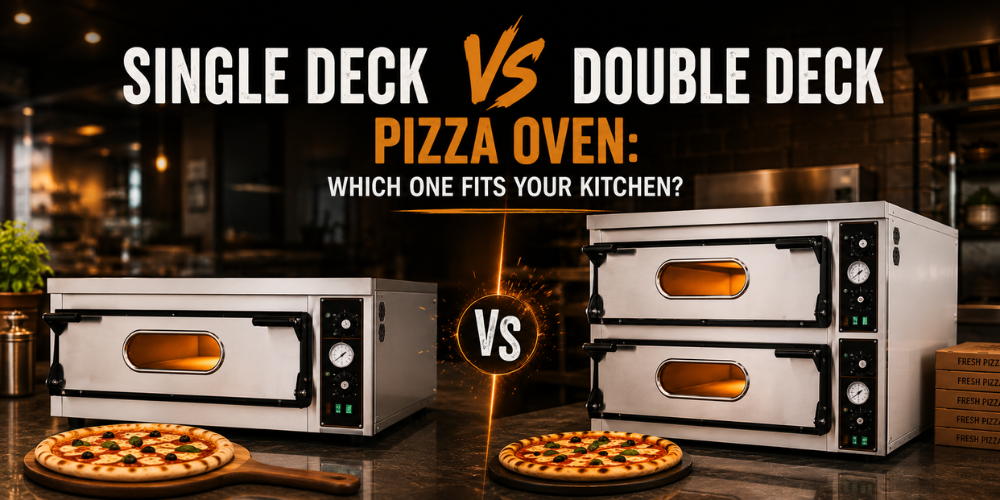
Deciding between a single-deck and a double-deck pizza oven is one of the most common questions first-time buyers face , and the instinct to assume “bigger is always better” isn’t necessarily right for every kitchen. The correct answer depends on your volume, space, and staffing, not on which option sounds more impressive.
What Single Deck Ovens Are Best For
A single deck oven , like the F1 Single Deck Pizza Oven , is built for kitchens where pizza is a focused, manageable part of the menu rather than the primary high-volume driver. It takes up less floor space, generally costs less upfront, and is simpler for a single operator to run confidently from day one.
Best for: Cafes, smaller restaurants, and kitchens adding pizza as a menu extension rather than building an entire concept around it.
What Double Deck Ovens Are Best For
A double deck oven, such as the F11 Double Deck Pizza Oven or the F44 Double Deck Professional Pizza Oven , effectively doubles your parallel cooking capacity without doubling your kitchen footprint, since both decks share the same base unit. This matters most during peak-hour service, when a single deck oven’s throughput becomes the bottleneck no matter how efficient the rest of the kitchen is.
Best for: Mid-to-high volume restaurants, pizzerias, and any kitchen where peak-hour order volume regularly exceeds what a single deck can comfortably handle.
Staffing Implications
A common concern is whether a double deck oven needs two people to run it. In most cases, no , a well-trained single operator can manage both decks efficiently, staggering batches between the top and bottom deck. Very high-volume service during extended peak hours may benefit from a second person assisting, but this is a staffing decision based on your order volume, not a strict requirement of the equipment itself.
Space and Cost Trade-Offs
| Factor | Single Deck | Double Deck |
|---|---|---|
| Floor space | Smaller footprint | Similar footprint, more vertical use |
| Upfront cost | Lower | Higher |
| Hourly output | Lower | Roughly double |
| Staffing | One operator, simpler | One operator (or two during peak) |
| Best for | Lower/steady volume | Higher or variable peak volume |
A Simple Decision Guide
Choose single deck if:
- Pizza is a menu addition, not your primary focus
- Your kitchen space is genuinely tight
- Your order volume is steady and predictable rather than spiking sharply at peak hours
Choose double deck if:
- You’re running a dedicated pizza concept or high-turnover restaurant
- You’ve noticed (or expect) significant order spikes during peak service
- You want room to grow into higher volume without needing a second oven purchase later
Explore Both Options
If you’re still weighing the two, it’s worth looking at both product lines directly , the F1 Single Deck for a focused, lower-volume setup, or the double deck range for kitchens planning around higher or growing demand.
FAQs
Does a double-deck oven cost significantly more to run than a single-deck oven? Running cost scales somewhat with usage , if you’re only using one deck at a time, cost is closer to single-deck levels; running both decks simultaneously naturally increases fuel or power draw relative to output.
Can I start with a single deck and upgrade to a double deck later? Yes, many restaurants start with a single deck oven and add capacity as order volume grows, though it’s worth planning kitchen space in advance if you expect to need double deck capacity down the line.
Is a double-deck oven harder to learn to operate? Not significantly, the core operation is the same as a single deck, just with two cooking surfaces to manage in rotation, which most staff adapt to quickly with basic training.