

Blog
How Many Pizzas Can a Commercial Pizza Oven Bake Per Hour? A Capacity Guide

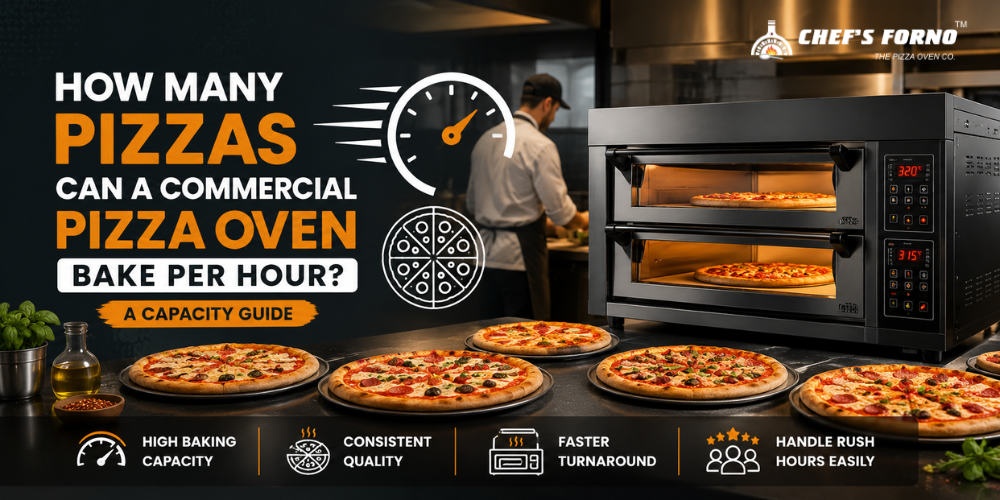
“How many pizzas can this oven actually handle in an hour?” is one of the first questions every restaurant owner asks before buying, and it’s also the one most sales conversations skip past. Get the answer wrong and you either end up with a queue out the door on a busy Friday night, or you’ve paid for a machine that spends most of its life half-empty.
Pizza oven capacity isn’t a single number stamped on a spec sheet. It depends on deck size, number of decks, cook time per pizza, and how quickly the oven recovers its heat after the door opens and closes repeatedly during service. Here’s how to actually work it out for your kitchen.
Why Getting Capacity Right Matters
Undersizing an oven is the more common mistake. A restaurant grows faster than expected, weekend footfall spikes, and suddenly the kitchen is bottlenecked, not because the chef is slow, but because the oven can only physically produce so many pizzas per hour, no matter how efficient the team is.
Oversizing has its own cost. A large multi-deck oven burns more fuel (or draws more power) to stay at temperature even when it’s half-empty, and it takes up kitchen real estate that could go toward prep space or another station.
The right size is the one that matches your actual peak-hour order volume, not your average, your peak.
How Capacity Is Actually Calculated
Three factors determine real-world output:
- Deck size: how many pizzas physically fit on the cooking surface at once
- Cook time per pizza, wood-fired ovens at very high heat cook a pizza in 90 seconds to 2 minutes; gas and electric decks running at moderate heat typically take 4-8 minutes, depending on style and thickness
- Recovery time, every time the door opens, heat escapes. A well-insulated oven regains temperature fast; a poorly insulated one loses several minutes of cooking time to recovery after every batch
Multiply pizzas-per-batch by batches-per-hour (accounting for recovery time) and you get a realistic hourly output, not the theoretical maximum quoted on a spec sheet.
Rough Output Ranges by Oven Type
These are typical ranges, not guarantees; actual output varies with pizza size, thickness, and operator skill.
| Oven Type | Typical Output (pizzas/hour) | Best Suited For |
|---|---|---|
| Single deck, compact | 20-30 | Cafes, low-volume menus |
| Double deck | 40-60 | Mid-size restaurants, steady weekend volume |
| Wood-fired, single chamber | 60-100+ (smaller pizzas, high heat) | Neapolitan-style, high-turnover pizzerias |
| Conveyor | 80-150+ | Very high volume, QSR/delivery-focused |
Matching Capacity to Your Restaurant Type
Cafes and low-volume menus where pizza is a menu addition, not the main draw, are usually well served by a compact single-deck setup; high output isn’t the priority, consistent quality with minimal footprint is.
QSR and high-turnover restaurants need to think in terms of peak-hour math: if you expect 40 pizza orders in your busiest hour, a 20-30/hour oven will leave customers waiting regardless of how good the kitchen team is. This is where a double deck pizza oven earns its keep: running two batches in parallel effectively doubles your throughput without doubling your floor space.
Cloud kitchens and delivery-first operations often need to plan around order clustering (multiple orders arriving in short bursts via delivery apps) rather than a steady walk-in flow, so recovery time matters even more than raw deck size.
Future-Proofing Your Choice
If you’re planning to grow, adding delivery, extending hours, or expanding the menu, it’s worth sizing slightly above your current peak rather than exactly matching it. Kitchens rarely get more space later; equipment upgrades mid-lease are far more disruptive than buying one size up at the start.
If you’re unsure where your numbers land, it’s worth talking through your covers-per-day and peak-hour order volume with the Chef’s Forno team directly , we can help match a model to your actual numbers rather than a generic recommendation. Get in touch here.
FAQs
1. How do I estimate my peak-hour pizza demand before opening?
Look at comparable restaurants in your area and format, or start conservative with a mid-range oven and plan for an upgrade path once you have real service data.
2. Does a double-deck oven need two chefs to run it?
Not necessarily, many double-deck ovens are designed so one trained operator can manage both decks, though very high-volume service may benefit from a second person during peak hours.
3. Is a bigger oven always a better value long-term?
No, a bigger oven that runs under capacity most of the week wastes fuel or electricity relative to its output. Right-sizing to your actual peak volume is usually more cost-effective than buying the largest available option.